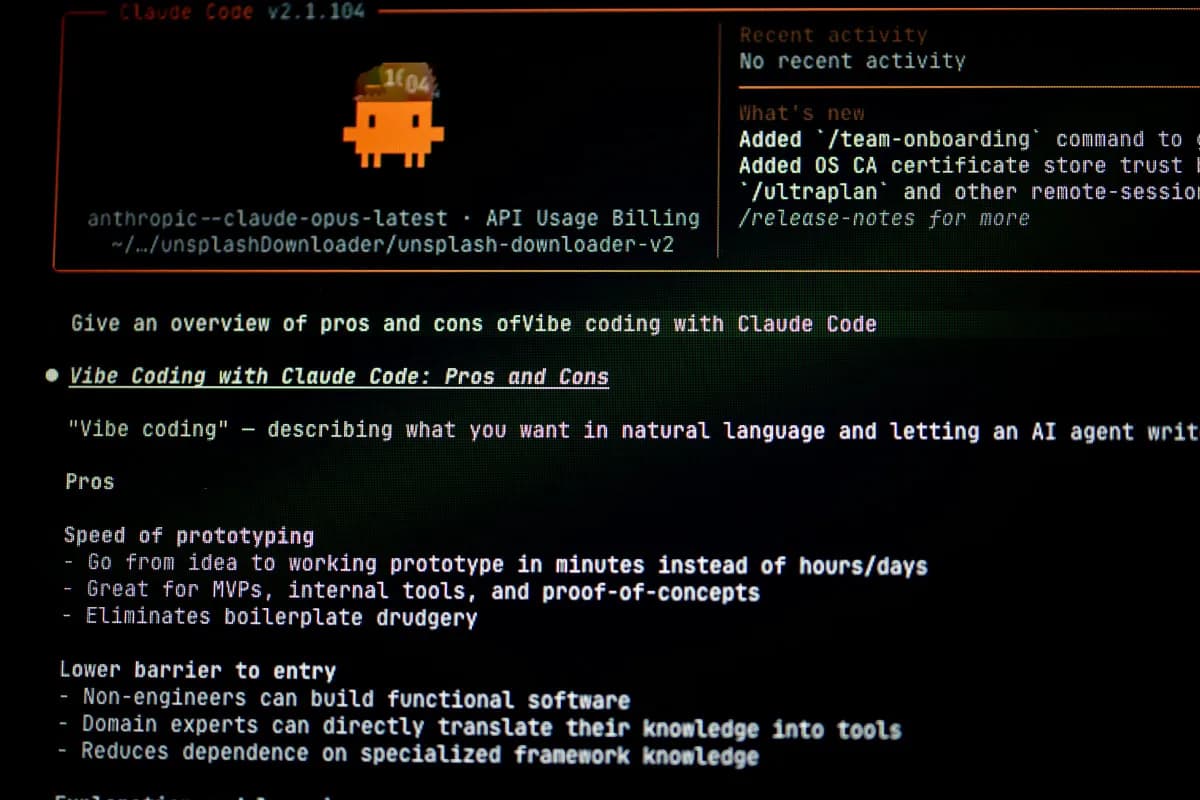
"Vibe coding" is the term that stuck for a simple idea: describe what you want in plain English, and let an AI agent like Claude Code write, run, and fix the code for you. We've spent real client hours working this way over the past few months, and the results are mixed enough to be worth writing down honestly, not as hype, not as fear, just what we've actually seen.
The pros
Speed of prototyping is the obvious win. Ideas that used to take a day of boilerplate now reach a working state in minutes. That compresses the distance between "what if we tried" and an actual clickable prototype, which changes how often we're willing to try something.
- Faster prototyping: from idea to working build in minutes, not hours or days
- Lower barrier to entry: domain experts and non-engineers can translate knowledge directly into working tools
- Less boilerplate drudgery: repetitive scaffolding, config, and glue code get handled automatically
- Faster debugging loops: an agent that can read its own error output closes the loop without context-switching to docs and forums
- Easier exploration: cheap to throw an approach away and try three more before committing to one
The cons
The same speed that makes vibe coding exciting is what makes it risky unsupervised. Code that works on the first try isn't the same as code that's correct, secure, or maintainable six months later. If nobody on the team understands what was generated, the project has a hidden single point of failure.
- Shallow understanding: it's easy to ship code nobody on the team can actually explain or debug later
- Inconsistent quality: output quality varies with how well the prompt captures constraints the agent can't infer
- Security blind spots: generated code can pass tests while still containing real vulnerabilities if nobody reviews it line by line
- Architectural drift: without a human steering long-term structure, a codebase can become a pile of locally-correct, globally-messy decisions
- Over-reliance risk: teams that skip the fundamentals can struggle the moment they need to work without the agent
Where we land
We treat Claude Code the way we'd treat a very fast junior pair: brilliant for getting a first draft on the screen, dangerous if it ships unsupervised. The studio rule that works for us is simple: vibe coding gets you to a draft, a senior engineer decides what's production-worthy. That keeps the speed without inheriting the risk.
If you're weighing whether to bring AI-assisted development into your own team's workflow, the honest answer is: it depends on whether you have the senior judgment in the room to catch what the agent gets wrong. Speed without review is just risk wearing a faster hat.